Dosimetry and spectrometry
Dosimetry ↑
Dosimetry characteristics od CdZnTe detectors ↑
Breadboard models of CdTe and CdZnTe dosimeters are developed for operation in counting and
continuous mode of operation. Dosimetric performances are tested in a vide range of γ-ray
dose rates


Correction of the energy dependence at the registration of gamma-radiation ↑
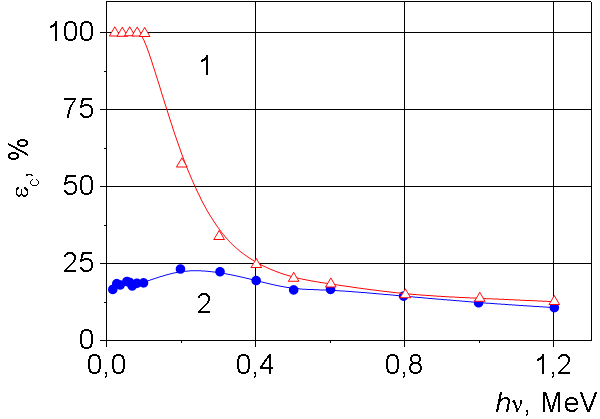
The effect of filters on the γ-quanta registration effectiveness was simulated for CdTe (CdZnTe) detectors with simple metal filters from Al, Сu, Cd, Sn, Pb, W of different width, with simple filters with different area of perforation, and with composite filters from different metals either with perforation or without it.
Emergency dosimeter for NPP ↑

BDBG-02 dosimeter was developed and manufactured for emergency situations at NPP. The dosimeter was tested at dosimetric calibration installations "ETALON-1M", UGV-1 and UGV-2 with 137Cs and 60Co sources. The tests were carried out also at “RADON” radioactive waste storage of the Kharkov region.
Effective range of gamma-ray dose rate is from 10 to 5000 R/h.
The data can be transmitted by cable at 50 m distance.


Spectrometry ↑
The ability to operate without cryogenic cooling allows to manufacture with CdTe and CdZnTe handy and easy-to-use equipment for gamma-spectroscopy. Detectors are equipped with Be windows (10-50 μm) of in-institute fabrication.


